Deal
Step-by-step instructions
Build useful comparisons
Choose several examples that match the item, brand, model, condition and completeness. Prefer completed transactions when available. Separate shipping from the item price and remember that an online seller may pay fees or provide returns. Local demand matters: a bulky desk may have fewer immediate buyers than a small appliance. Record your evidence alongside the asking price, not just the highest number you found.
Price categories using the right unit
For clothing, compare size, brand, wear and whether pieces form an outfit. For books, distinguish ordinary reading copies from collectible editions. For furniture, include dimensions, stability, finish and loading requirements. For tools, note brand, missing components and safe function. Toys and games need completeness checks; electronics need a test record and accessories. Price kitchen sets as sets only when the contents are clear. A bundle's count should appear on the label.
Choose your asking price and a private floor
Set an opening price you can explain and a minimum you would accept for each valuable piece. The gap is your negotiation room, not a promise of a discount. Keep minimums in a private note or inventory sheet. If your minimum is close to a specialist market value, consider another sales channel. Avoid raising a posted price when you see interest: consistent pricing helps prevent arguments.
Use bundles selectively
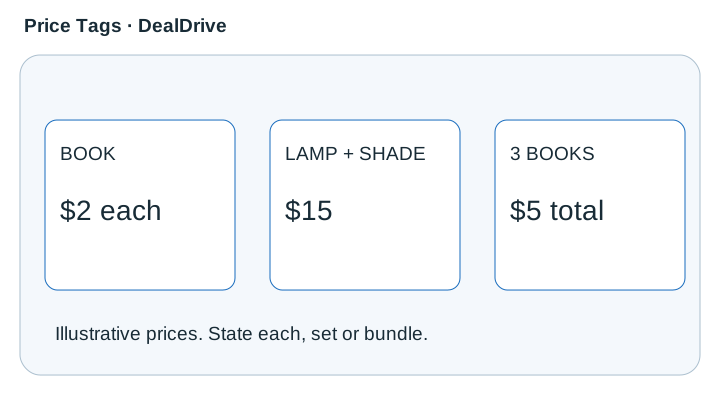
Bundle related inexpensive goods that a buyer can use together. For example, three ordinary paperbacks for $5 instead of $2 each illustrates a quantity discount; it is not a market valuation. Keep valuable books separate. A mixed box with hidden damage creates distrust. State whether buyers can choose the items and whether the offer applies to all goods in the category.
Plan reductions before opening
Choose a review time, such as the final hour, and decide which goods can be reduced. Change tags or display a clear sign explaining the scope of the discount. Do not apply a blanket half-price notice if some goods are excluded without identifying those exceptions. Avoid contradictory arithmetic: if tags are already reduced, tell buyers whether another discount applies.
Brief the person taking payment
Give helpers a clear list of firm prices and bundle rules. Agree how they will ask you about offers without announcing private minimums to everyone. At checkout, identify the goods, calculate the total and confirm it before payment. Mark the actual received amount in the tracker. Asking-price totals are not earnings; only completed paid sales belong in revenue.
Illustrative prices by category
These invented examples illustrate pricing units and bundles, not market valuations or recommended prices. Use either USD or CAD consistently; the numbers are not currency conversions. Research your exact goods locally.
| Category | Example item | Illustrative tag | Check first |
|---|---|---|---|
| Clothing | Clean everyday shirt | $3 each; two for $5 | Separate valuable brands and disclose stains or repairs. |
| Books | Common reading copies | $2 each; three for $5 | Research signed, scarce or specialist editions separately. |
| Toys | Complete board game | $6 for the complete game | Count pieces and check recalls before offering it. |
| Kitchenware | Matching set of four mugs | $8 for the set | State the number of pieces and disclose chips. |
| Tools | Used hand-tool set | $12 for the listed pieces | Verify brand, wear and completeness before comparing prices. |
| Electronics | Tested basic speaker with charger | $15 for device and charger | Exact model, battery condition and missing accessories change value. |
| Furniture | Used side table with disclosed wear | $30 asking; private minimum $20 | Record dimensions and collection requirements. |
| Sporting goods | Used non-protective equipment | $10 for the described item | Size, condition and season affect demand; screen safety-sensitive goods. |
| Collectibles | Unidentified marked vase | Research before pricing | Do not infer authenticity or rarity from age or appearance. |
 View diagram at full size (opens an enlarged view) ↗
Research realistic comparisons
Compare similar used goods by brand, age, condition, completeness and local demand. Completed sales, where available, are more informative than ambitious asking prices. Original retail cost is context, not a guarantee of resale value.
Decide whether your priority is the highest possible return or clearing space within a few hours. Specialist goods may need more research than everyday household items.
Choose an asking price and a private minimum
Record your asking price and lowest acceptable amount for valuable items. Keep minimums private. Decide which prices are firm and whether you will reduce prices near closing.
If comparable lamps sell locally for 10–20 in your currency, compare your lamp's condition and completeness before choosing a price. A damaged or unusual lamp may fall outside that range.
Make labels unambiguous
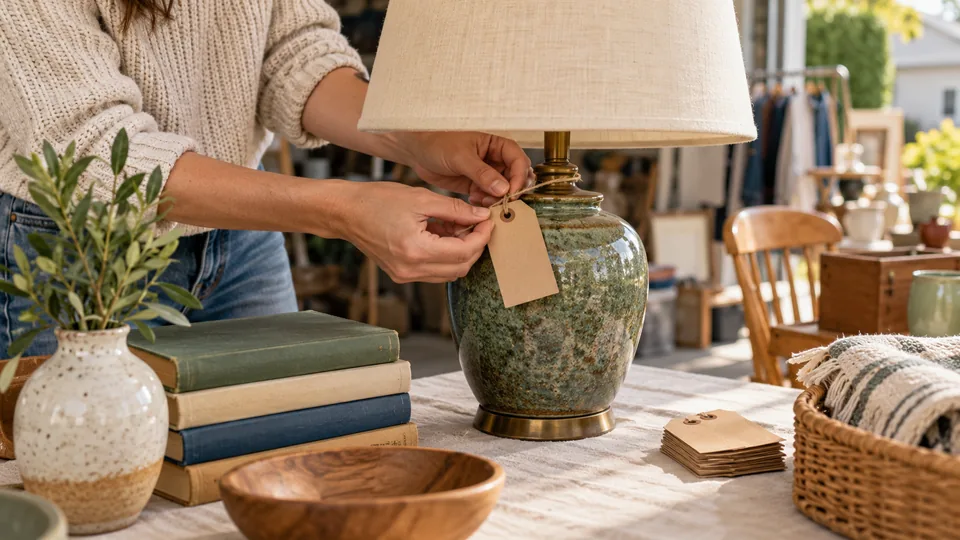
Price each item or clearly mark a table where everything has the same price. State whether a price is per piece or for a whole set. Use readable labels that will not damage surfaces or fabric.
Keep higher-priced goods off the inexpensive-item table. Give helpers a price list for valuable goods so shoppers get consistent answers.
Use bundles and quantity discounts
Related low-cost goods often suit bundles: books, matching kitchenware or craft supplies. An example such as 'one book for 2, three for 5' explains a quantity discount clearly; adapt the amounts to local demand and your minimum.
Do not hide damaged items inside a bundle. Agree what is included and confirm the total before taking payment. A clearly marked inexpensive-item table can reduce repetitive questions.
Negotiate politely
Try 'I can do that price if you take both,' or 'That one is firm, but these are flexible.' You can decline an offer without arguing. Agree the total before payment and avoid promises you cannot honour.
- Decide firm and flexible prices before opening.
- Brief helpers on discount rules.
- Review unsold goods at an agreed time.
- Keep condition descriptions honest when reducing prices.
Choose a reduction rule you can explain
Make reductions a planned decision rather than a response to every quiet moment. Select a review time, identify eligible categories and set a limit on the discount. If a lamp is tagged at an illustrative $15 with a private minimum of $10, a late-day $12 offer may fit your plan; an $8 offer does not unless you deliberately change the goal. Decide whether the cashier may negotiate or must ask the owner. For bundles, confirm the final contents and total before accepting payment, then record that actual receipt rather than the original tag sum. Do not invent a higher 'original' price to make a discount look larger. Keep excluded goods in a clearly separate area, especially when several households share the sale.
A real-world example
Illustrative pricing worksheet: a lamp is labelled $15, your private minimum is $10, and a matching shade is included. A buyer offers $8. You respond, 'I can do $12 with the shade.' If the buyer takes a separate $4 basket, you might agree $15 for both only if that fits your minimums.
Common mistakes
- Using original retail cost as the only reference.
- Leaving labels ambiguous about each versus per set.
- Letting multiple helpers offer incompatible discounts.
Practical checklist
Frequently asked questions
Should everything be cheap?
Prices should fit condition, demand and your goal. Valuable goods do not need to be sold below your minimum just because the event is a garage sale.
How do I price used clothing?
Compare similar brands and condition locally, separate special pieces, and use clearly labelled size groups or bundles for ordinary basics.
Should I put prices online?
Prices for featured goods can reduce repetitive questions. Keep online figures consistent with labels and update them when they change.
What if nobody buys an item?
Consider visibility, condition, demand and transport before assuming price is the only problem. Decide whether a reduction or another channel makes more sense.